
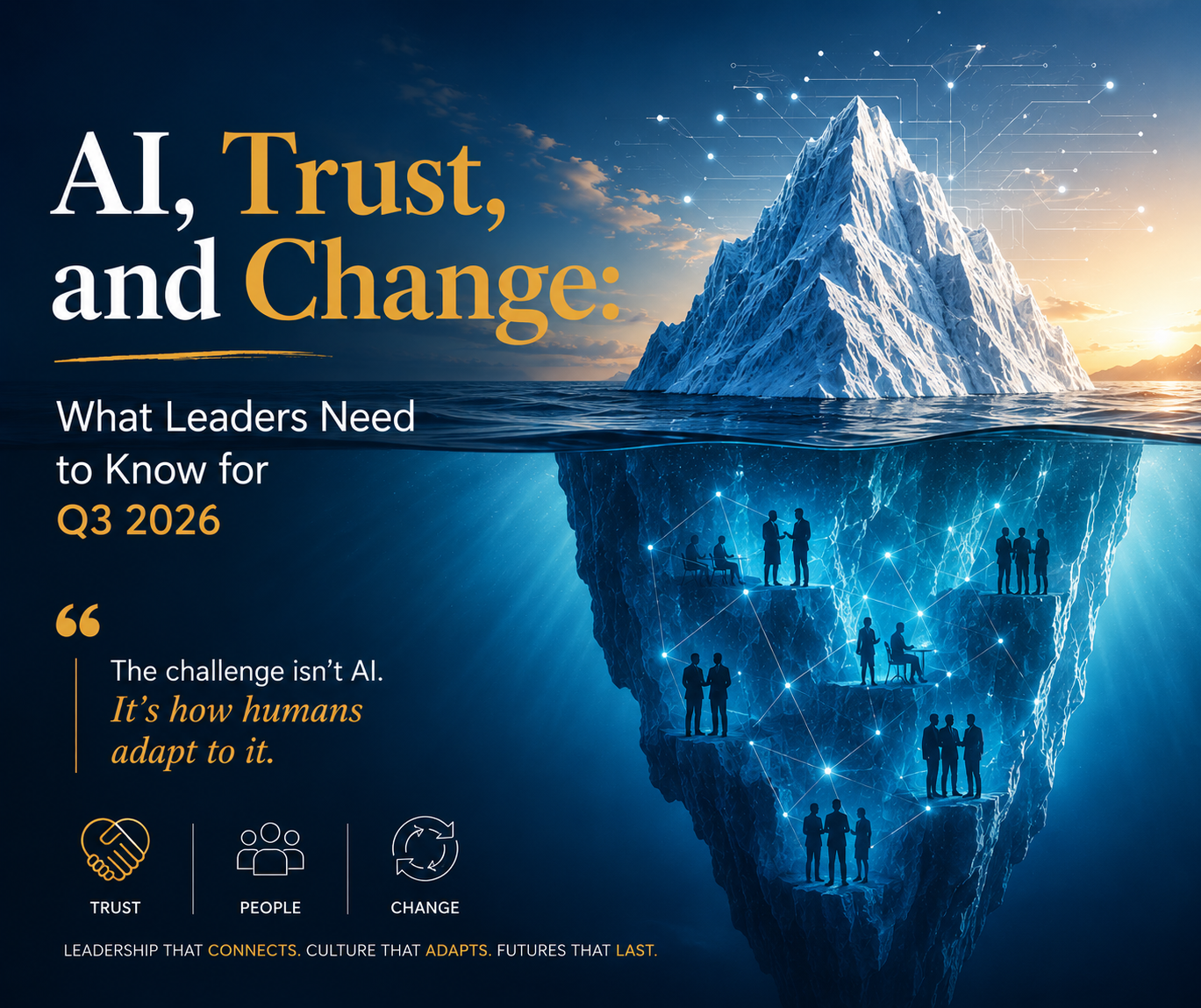
AI, Trust, and Change: What Leaders Need to Know for Q3 2026
Every quarter brings a new list of trends, predictions, and urgent priorities. Leaders are discovering that the real challenge is deciding what deserves their attention.
As we move into Q3, here are three industry agnosticshifts that are emerging and they are all about AI.
1. AI Is Moving from Experimentation to Expectations
Many organisations have been experimenting with AI and getting the expected efficiencies.
Yet, many organisations are struggling to translate those gains into meaningful business results. In Q3, the conversation is shifting from "Should we use AI?" to "Why aren't we getting more value from it?"
This is a back to basics issue for me because leaders are attempting to layer AI onto existing processes rather than redesigning how work gets done.
2. Trust Is Becoming a Competitive Advantage
Employees are watching how organisations make decisionsabout AI, budgets, restructuring, and change.
Recent examples of companies diverting resources fromcompensation to AI investments have sparked debate about trust, transparency,and organisational priorities. Leaders who communicate clearly and involveemployees in change will have a significant advantage over those who rely ontop-down directives.
Trust determines whether people engage, innovate, andstay.
3. The New Leadership Skill Is AI Fluency
AI literacy and workforce readiness are critical leadership capabilities.
Leaders need to be fluent in AI.
This means understanding the prompts, asking great questions, evaluating risks ( I saw an article where a company’s data base was eroded with AI), and help your team useAI responsibly. It may mean that an AI policy is required because while you leader may not be using it your staff may be putting sensitive data into these models.
4. Managers Are Being Asked to Lead Differently
Many middle managers were trained to allocate resources, monitor activity, and track performance.
Now that AI is doing most of these activities, leaders need to refocus.
Leaders now need to focus on creating psychological safety, designing work, enabling collaboration, removing barriers, and developing people. Leaders’ role is to create conditions that support performance.
5. Human Skills Are Becoming More Valuable, Not Less
As technology becomes more powerful and does the heavy lifting, the uniquely human skills become even more critical. These include strategic thinking, critical thinking, emotional intelligence, conflict resolution, communication and creativity.
The organisations that can combine technological capability with human wisdom will be those that thrive.
If you want to implement any of these then book a callwith me. Get some tips from my book Change or Die to redesign your businessProcesses.


